Reaching an Associate
Revising routing for intent bots in insurance.
Role
Content strategist
Industry
Fintech
Duration
Dec 2024 - Jan 2025
Identify the ask
I needed to revise the automated phone (IVR) experience to reduce the amount of callers who were unable to reach an associate. Although the business needs some callers to self-service in the IVR, callers aren't happy if they can't talk to a person like they ask.
Audience
The user here is specifically a caller who asks to talk to an associate immediately, and is uninterested in using the phone menu. All callers are customers of automobile insurance policies, calling in regards to a broad variety of products.
The problem to solve
Callers aren't reaching an associate, even though they are asking for one at the start of the phone experience.
This portion of the phone experience is called the associate flow, but it's not connecting the caller to a person (quickly or at all). Instead, the system is sending the caller to self-service flows.
I realized the previous enhancement to the flow caused this new problem because it pushed callers to the newly-available self-service options even if they specified wanting to talk to a person.
The problem's source
I reviewed the previous version of the experience and created high-level flows to explain to stakeholders how the function of the IVR system had changed.
Figure 1
When I first built the associate flow, there were no self-service options. All calls reached an associate, and the flow elicited information from the caller to get them to the right person.
Figure 2
My error was in leveraging the new self-service functions when the caller didn't request them. Callers would ask for an associate, and then the IVR would ask them the reason (bot-speak: intent). If the intent had a self-service option, the IVR would send the caller there, rather than to an associate.

Figure 1 – The original phone experience doesn't have self-service features. The IVR tries to understand what the caller needs so it can send them to the right associate.

Figure 2 – The current (problematic) phone experience. Despite having asked to talk to someone, callers may be sent down a self-service path.
Strategy
My objective to serve the user conflicts with the business objective to use the IVR to deflect calls from the callcenter. I prepared two high-level solutions to discuss with stakeholders how much we wanted to cater to the caller who asked for an associate.
Figure 3
Proposal A – if a caller asks for an associate, they may be asked some questions, but they won't be sent to self-service.
I felt this solution wasn't fast enough for a caller who wanted to talk to a human because it still relied on the original flow that collected a lot of info. Additionally, this solution would require changes and dev work across different flows, likely implying more work in future features as well.
Figure 4
Proposal B – if a caller asks for an associate, they get a simplified menu and are connected to a human.
I advocated for this proposal because it's an empathetic reaction to a caller who's rushed or uncertain. It treats the caller's request for an associate as a unique intent, with its own treatment. The experience has more scaffolding to guide the caller. This proposal is also centralized on one flow, which means easier documentation and development.

Figure 3 – Alternative proposal A didn't satisfy the caller's immediate need for a human.

Figure 4 – Chosen solution B efficiently provided the caller with what they needed.
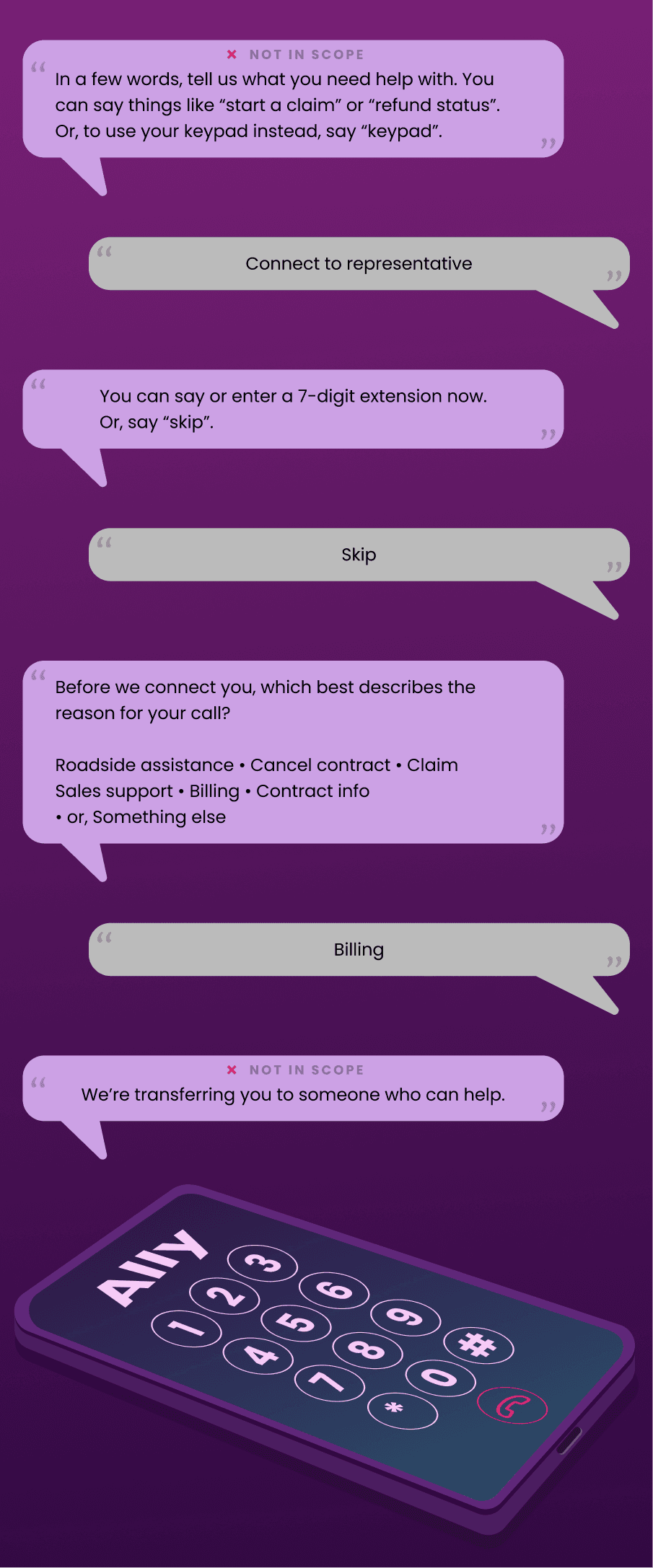
Solution - sample conversation
Phone system: |
Caller: |
Phone system: |
Caller: Skip |
Phone system: Before we connect you, which best describes the reason for your call? |
Caller: Billing |
Phone system: We're transferring you to someone who can help. |
More images

The prior state of the associate flow (designed on Axure).

The solutioned state of the associate flow (designed on Axure).